

Laboratory for Information & Decision Systems
At the forefront of decision-driven intelligence towards the infusion of computing in physical, societal and sustainable systems
About us
The Laboratory for Information & Decision Systems advances computing at its most consequential — pioneering algorithms and systems to improve human and autonomous decision making even in the most complex settings.
A new era of computing is emerging. For decades, the field has been driven by the ability to analyze data and generate increasingly accurate predictions. While these capabilities remain foundational, the next chapter moves beyond prediction, toward enabling intelligent decisions. Many of these decisions lead to direct actions that are embedded in the physical world and the social fabric of our lives.
Decision-driven intelligence brings together ideas from statistics, optimization, control, economics, and behavioral science to build systems that reason about uncertainty, incentives, constraints, and interactions from a human-centered perspective: computing should augment human capabilities and expand human potential, enabling people to make better decisions and lead better lives than would otherwise be possible.


Focus areas
Lorem ipsum dolor sit amet, consectetur adipiscing elit, sed do eiusmod tempor incididunt ut labore et dolore magna aliqua. Statistics, optimization information and inference.



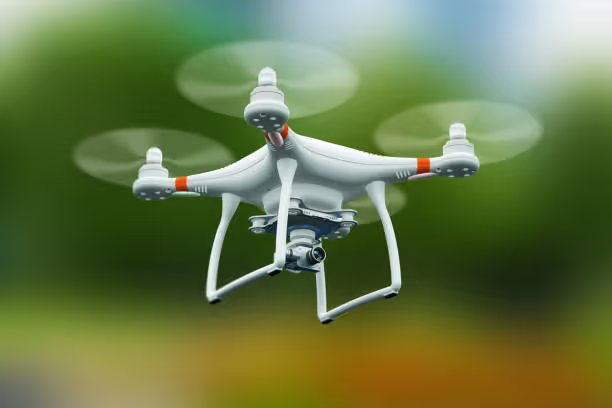
Algorithms that have more Autonomy and Agency require careful design and extensive human collaboration. Lorem ipsum dolor sit amet, Decision making, systems, and robotics.


Computing research can have consequential societal implications. Lorem ipsum dolor sit amet, consectetur adipiscing elit.



Computing can enable sustainable living and development, only when it is utilized in a sustainable manner. in many Lorem ipsum dolor sit amet, consectetur adipiscing elit.




























people




























Focus areas



The four focus areas of our research ensure impactful advances in computing foundations and its transformative applications: Machine Learning and Data Science, Autonomy and Agency, Computing and Sustainability, Computing and Society.
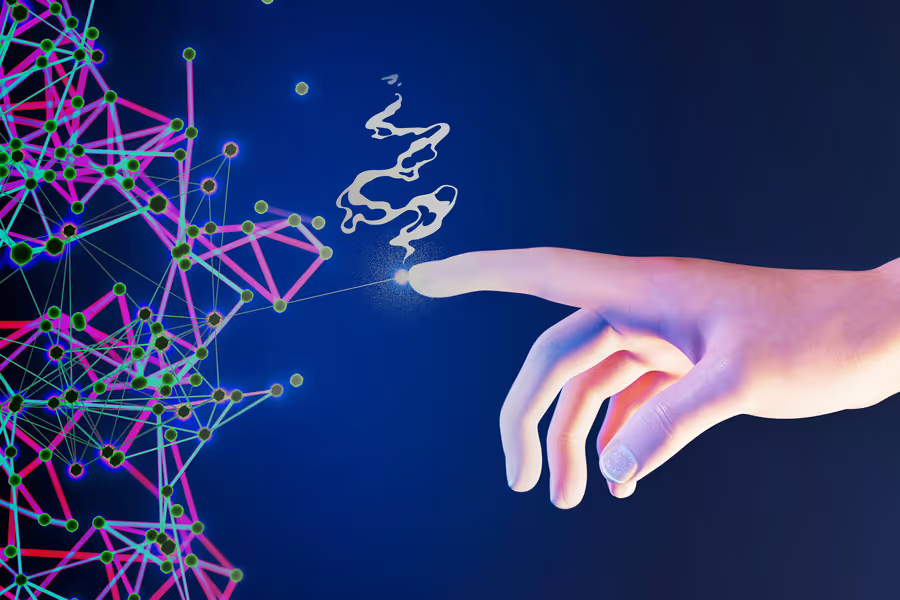
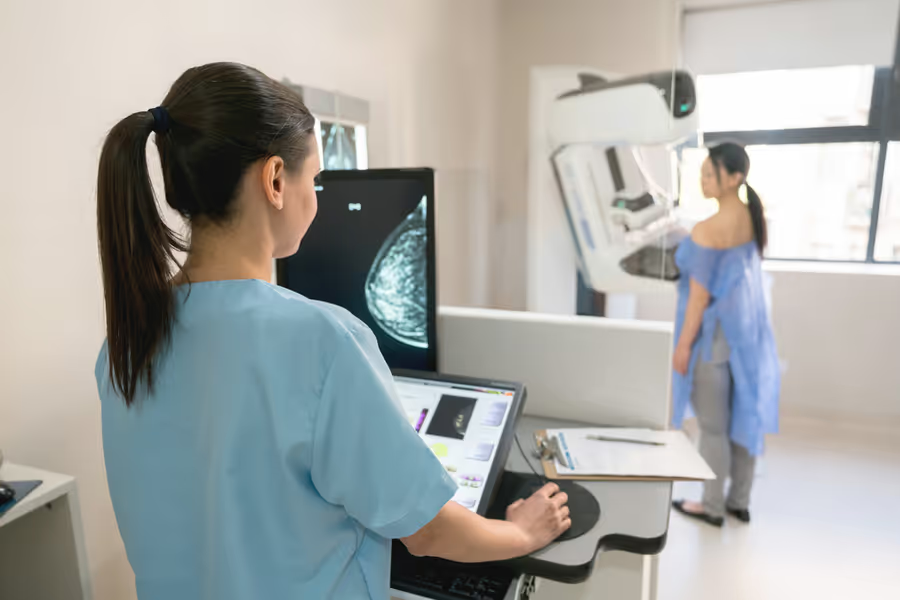
LIDS research addresses and is driven by broad challenges, emerging applications, critical needs, and intellectual opportunities for technological advances. LIDS plays a key role in identifying novel directions and advancing the state of the art in several industries, such as Aerospace, Automotive, Communications and Networks, Energy and Infrastructure, Finance, Healthcare, Human Resources, Robotics and Autonomous Vehicles, Sustainability and Environment, Transportation, and more.


LIDS PIs engage in numerous research fields, including Statistics, Statistical Inference, Probability and Stochastic Processes, Optimization, Game Theory, Autonomous Systems, Robotics, Reinforcement Learning, Sequential Decision Making, Learning for Control, Control Theory, Information Theory, Communications and Networks, Theory of Computation.

Stay up-to-date with the LIDS Latest newsletter


Massachusetts Institute of Technology
Room 32-D608
77 Massachusetts Avenue
Cambridge, MA 02139

